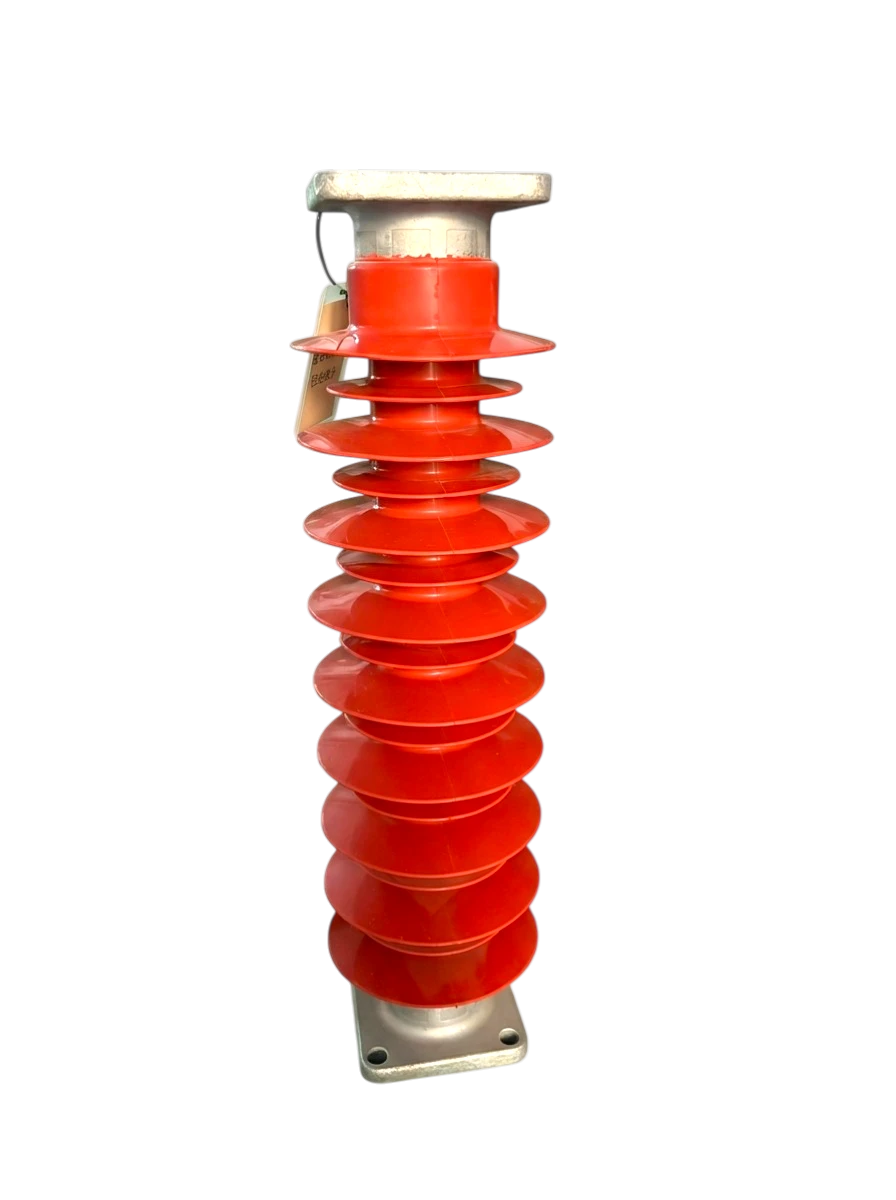
Composite Insulators
Post · Suspension · Dead-End
FRP core with HTV silicone rubber housing. 60% lighter than porcelain equivalents. Post insulators to IEC 61952 (12–252 kV), suspension to IEC 61109 (35–500 kV). Engineered for severe pollution environments where porcelain requires frequent washing.
IEC 61952 & IEC 61109 — Full Series Data
Composite Post Insulators — IEC 61952
FRP core with HTV silicone rubber housing. Manufactured to IEC 61952. For substations, distribution and transmission lines from 12 kV to 252 kV. Significantly lighter than equivalent porcelain station post. Custom bending loads and 380 kV+ available.
| Voltage (kV) | Bending (kN) | Height (mm) | Creepage (mm) |
|---|---|---|---|
| 12 | 4 | 215 | 385 |
| 24 | 8 | 350 | 385 |
| 40.5 | 8 | 445 | 650 |
| 72.5 | 4 | 770 | 1,160 |
| 126 | 4 | 1,220 | 2,015 |
| 126 | 8 | 1,220 | 2,015 |
| 126 | 12.5 | 1,220 | 2,015 |
| 252 | 8 | 2,300 | 4,030 |
| 252 | 12.5 | 2,300 | 4,030 |
| 252 | 16 | 2,300 | 4,030 |
Manufactured to IEC 61952 · Custom bending load and 380kV+ available with GA drawing · Flange dimensions configurable
Polymer Suspension Insulators — IEC 61109
Long-rod design with ECR glass FRP core and HTV silicone rubber sheds. Hydraulically crimped forged steel end-fittings. For transmission lines 35 kV to 500 kV. SML 70–300 kN. Corona rings supplied for 220 kV and above.
| Voltage (kV) | SML (kN) | Creepage (mm) | Coupling L. (mm) | Wt. (kg) |
|---|---|---|---|---|
| 110 | 70 | 2,670 | 1,182 | 4.1 |
| 110 | 70 | 2,930 | 1,282 | 4.3 |
| 220 | 100 | 4,840 | 2,122 | 8.2 |
| 220 | 100 | 5,950 | 2,122 | 8.8 |
| 345 | 120 | 8,390 | 2,822 | 11.5 |
| 400 | 120 | 10,400 | 3,522 | 14.5 |
| 500 | 120 | 11,980 | 4,322 | 15.3 |
| 400 | 210 | 9,270 | 3,620 | 24.7 |
| 500 | 300 | 11,980 | 4,350 | 43.3 |
End-fittings: Ball/Socket · Clevis · Eye · Tongue (specify on inquiry) · 220 kV+ assembled with corona ring(s) · Custom SML and creepage available
Where Composite Insulators Are Used
Coastal & Marine Pollution
Severe salt-fog environments where porcelain requires frequent washing. HTV silicone rubber provides superior hydrophobicity — moisture beads off even under extreme contamination, maintaining insulating performance without maintenance.
Long-Span Transmission
110–500 kV transmission corridors. Suspension insulators are 60% lighter than equivalent disc strings — lower tension loads, reduced tower structural requirements, faster installation.
Industrial Corridors
Cement plants, chemical zones, refineries. Composite insulators maintain dielectric performance in chemical-aggressive environments where porcelain glaze degrades over time.
Composite Insulator FAQ
Composite post insulators (IEC 61952) are rigid — designed for direct mounting to poles and structures where the insulator must support the conductor in a fixed position, equivalent to a porcelain post or station post insulator. Polymer suspension insulators (IEC 61109) are flexible long-rod units designed for hanging strings — connecting tower crossarms to conductors in tension. Both use the same FRP core and HTV silicone rubber housing technology, but differ in mechanical design and end-fitting configuration.
HTV silicone rubber has a permanent hydrophobic surface — water forms beads rather than a continuous film, which dramatically reduces leakage current even under heavy contamination. Porcelain is hydrophilic: surface moisture forms a conductive film that can lead to flashover in heavy pollution. In severe environments (IEC 60815 Class C–E), composite insulators can extend maintenance intervals from annual washing to 5–10 years or more, significantly reducing lifecycle costs.
Standard configurations include Ball/Socket (compatible with disc insulator strings), Clevis & Tongue, and Eye fittings. End-fitting type must be specified at order time as it affects the crimping die and hardware dimensions. For 220 kV and above, corona rings are assembled and supplied with the insulator — specify the tower geometry and conductor configuration for corona ring sizing.
In most cases, yes. Composite post insulators to IEC 61952 are mechanically interchangeable with IEC 60273 porcelain station posts of equivalent voltage and bending load rating. The key advantage is weight — a 126 kV composite post weighs approximately 8 kg versus 40–60 kg for equivalent porcelain. Flange dimensions can be configured to match your existing bracket dimensions — provide your current insulator drawings and we will confirm compatibility.
Routine tests per IEC 61109 / IEC 61952 for every batch: visual inspection, dimensional check, mechanical load test, power frequency voltage test, and hydraulic crimping pull-out test on end-fitting samples. Type-test reports per IEC 61109 and IEC 61952 available for standard configurations. Third-party inspection (SGS, BV, Intertek) is welcome at any production stage.
Get a Technical Proposal for Composite Insulators
Specify your product type, voltage, and quantity. Our engineers respond within 6 hours with pricing, lead time, and applicable test reports.